Company Registration in Singapore for Local Residents
If you are a Singapore citizen or permanent resident planning to start a business, a Private Limited Company is one of the most structured and recognised forms through which a business can be operated in Singapore. Here’s everything you need to know.
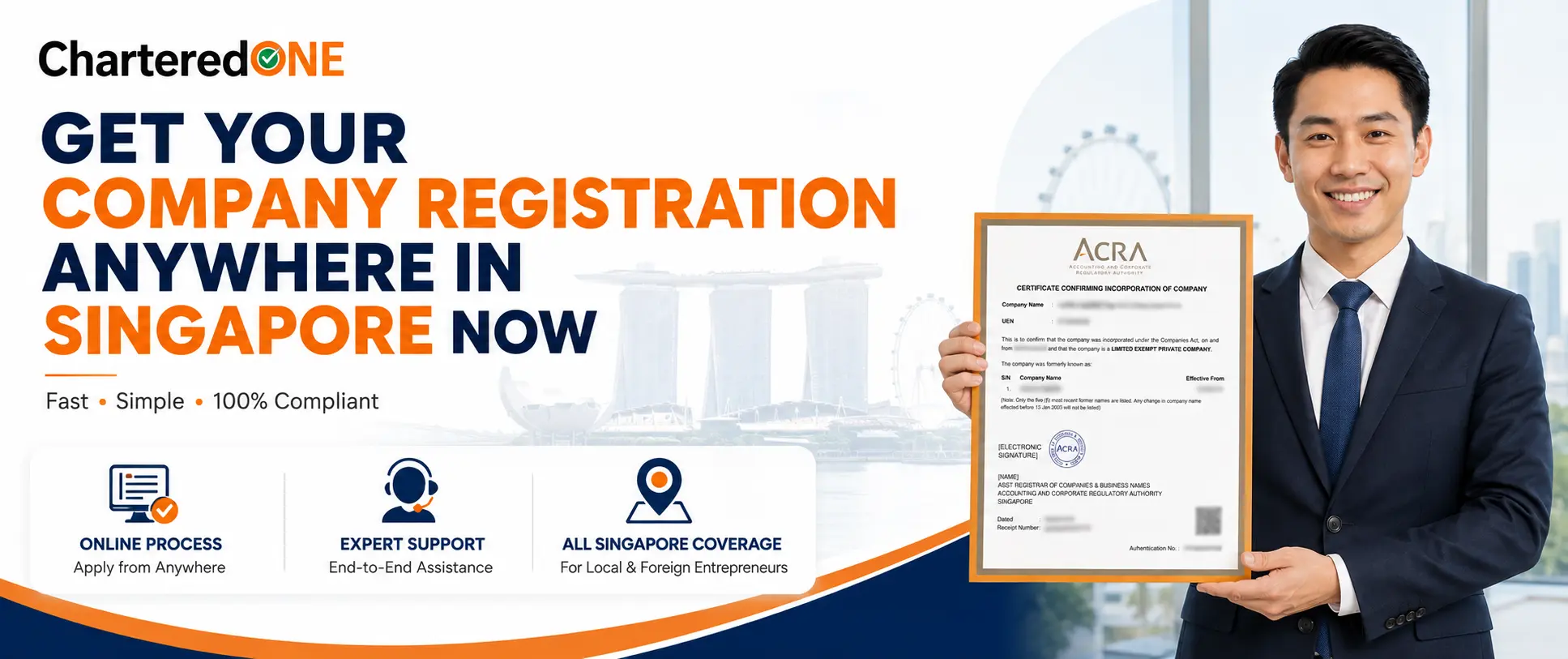
Company registration in Singapore is the legal process through which a business entity is incorporated with the Accounting and Corporate Regulatory Authority, commonly known as ACRA. Once registered, the company receives a Unique Entity Number, which becomes the main identification number of the company for dealing with banks, government agencies, customers, suppliers and other authorities.
For Singapore citizens and permanent residents, company registration is comparatively straightforward because the local resident director requirement may generally be satisfied by the founder himself or herself, provided the person is eligible to act as a director.
A nominee director arrangement is generally not required where the proposed company already has at least one director who is ordinarily resident in Singapore.
However, company registration is not only about reserving a name and filing an application. The founders should properly decide the shareholding structure, directors, paid-up capital, financial year end, registered office, business activities, company constitution and post-incorporation compliance before proceeding with the registration.
An incorrect structure at the time of registration may create practical difficulties at the stage of bank account opening, licence application, tax registration, investor onboarding, shareholder restructuring or annual compliance.
CharteredONE assists Singapore residents with company structure planning, name reservation, document preparation, ACRA registration coordination and post-incorporation compliance support.

What is Company Registration in Singapore?
Company registration is the legal process through which a new company is incorporated and entered in the register maintained by ACRA.
It is one of the most essential steps required to operate a business under a separate legal entity. Once the application is approved, the company is allotted a Unique Entity Number, commonly called UEN.
The UEN is used by the company while dealing with:
| Particulars | Details |
| Government agencies | For statutory filings, tax matters and official correspondence |
| Banks | For corporate bank account opening and KYC |
| Customers | For invoicing and business identification |
| Suppliers | For contracts, purchase orders and vendor onboarding |
| Employees | For payroll, CPF and employment-related compliance |
| Regulators | For licence applications and statutory registrations |
A registered company is legally distinct from its shareholders and directors. The assets, liabilities, contracts and obligations of the business belong to the company and not directly to the individuals who own or manage it.
For most small and growing businesses, the commonly selected structure is a Private Company Limited by Shares, generally displayed with the words “Private Limited” or “Pte. Ltd.” after the company name.
A private company limited by shares may have up to 50 shareholders. Share capital is required, and the liability of shareholders is generally limited to the amount invested or agreed to be invested in the company.
Who is Considered a Local Resident for Company Registration?
For the purpose of company registration, local residents generally include:
- Singapore citizens.
- Singapore permanent residents.
- Other eligible persons who satisfy the local residency requirement and are legally permitted to act as directors.
Every Singapore company must have at least one director who is ordinarily resident in Singapore.
The director should generally satisfy the following conditions:
| Particulars | Details |
| Age | Must be at least 18 years old |
| Capacity | Must be mentally capable of making decisions |
| Residency | Must be ordinarily resident in Singapore |
| Disqualification | Must not be disqualified from acting as director |
| Information | Must provide required personal and residential information |
A Singapore citizen or permanent resident who satisfies these conditions can generally act as the locally resident director of the company.
A nominee director is therefore not automatically required for a company owned by Singapore residents. It becomes relevant mainly where none of the proposed directors satisfies the local residency requirement
Why Register a Private Limited Company in Singapore?
The appropriate business structure depends on the nature of the business, number of owners, liability exposure, investment plans, licensing requirements and long-term commercial objectives.
However, many founders prefer a Private Limited Company because it provides a formal and organised structure for ownership, governance and future growth.
1. Separate Legal Identity
A registered company has a legal identity separate from its shareholders and directors.
The company can:
- Enter into agreements.
- Own business assets.
- Employ workers.
- Borrow money.
- Invoice customers.
- Acquire intellectual property.
- Sue or be sued.
- Continue operating despite changes in ownership.
This separation helps distinguish the business activities and obligations of the company from the personal affairs of its owners.
2. Limited Liability
The liability of shareholders of a company limited by shares is generally restricted to the amount unpaid on their shares.
However, limited liability does not protect a director or shareholder from personal responsibility arising from fraud, personal guarantees, unlawful conduct, breach of duty or any other circumstance where personal liability may apply.
3. Professional Business Structure
A Private Limited Company provides a recognised structure while dealing with:
| Particulars | Examples |
| Customers | Commercial clients, enterprise customers and overseas customers |
| Government agencies | Licence applications, grants and statutory filings |
| Financial institutions | Corporate bank accounts and credit facilities |
| Suppliers | Vendor registration and contract onboarding |
| Investors | Share subscription, equity investment and due diligence |
| Landlords | Commercial lease and office arrangements |
The company operates under its registered name and UEN, helping establish a separate business identity.
4. Flexible Ownership
The ownership of a company is divided through shares.
Founders can decide:
- The number of shares to be issued.
- The value of shares.
- The percentage held by each shareholder.
- The rights attached to different classes of shares.
- The procedure for transferring or issuing shares.
The shareholding structure should be properly decided before registration, particularly where there are two or more founders.
5. Continuity of Business
A company does not ordinarily cease to exist merely because a shareholder or director resigns, dies or transfers shares.
The company can continue until it is formally struck off, wound up or otherwise dissolved in accordance with law.
6. Ability to Raise Capital
A company can raise funds by issuing additional shares, bringing in new investors or obtaining business finance.
Any issue or transfer of shares must be properly approved, documented and filed with ACRA wherever required.
7. Corporate Tax Treatment
Singapore companies are generally taxed at the prevailing corporate income tax rate on chargeable income.
Qualifying new companies may be eligible for the start-up tax exemption scheme during their first three consecutive Years of Assessment.
Under the current framework, qualifying companies may receive:
- 75% exemption on the first S$100,000 of normal chargeable income.
- Further 50% exemption on the next S$100,000 of normal chargeable income.
Eligibility is subject to the prescribed conditions. Incorporating a company does not automatically guarantee that the company will qualify for the exemption.
Private Limited Company, Sole Proprietorship or LLP
Local founders should select the business structure based on liability, number of owners, compliance requirements and long-term business plans.
The lowest-cost structure is not always the most appropriate structure. Founders should consider future banking, taxation, investment, licensing and compliance requirements before deciding.
| Basis of Differentiation | Sole Proprietorship | LLP | Private Limited Company |
| Legal status | Not separate from owner | Separate legal entity | Separate legal entity |
| Ownership | One individual | Two or more partners | Shareholders |
| Management | Proprietor | Partners / Managers | Directors |
| Liability | Proprietor may be personally liable | Liability may be limited subject to law | Shareholders' liability generally limited |
| Continuity | Linked to proprietor | Continues subject to LLP structure | Continues despite change in shareholders/directors |
| Investment structure | Not share-based | Not share-based | Share-based ownership |
| Suitability | Small owner-managed business | Professional or joint business structure | Growing business, investor structure and formal operations |
Sole Proprietorship
A sole proprietorship is owned by one individual. The business and the proprietor are not separate legal persons.
It may be suitable for a small business where the owner wants a simple structure. However, the proprietor may remain personally responsible for the debts and obligations of the business.
Limited Liability Partnership
An LLP is a separate legal entity that combines certain features of a partnership and a corporate structure.
It may be suitable where two or more professionals or business owners wish to operate jointly while maintaining organisational flexibility.
Private Limited Company
A Private Limited Company is owned through shares and managed by its directors.
It is generally more suitable where the founders intend to:
- Build a long-term business.
- Employ staff.
- Introduce investors.
- Separate business liabilities.
- Expand into multiple activities.
- Enter larger commercial contracts.
- Create a transferable ownership structure.
Requirements for Company Registration in Singapore
Before registering a Private Limited Company, the founders must satisfy certain basic requirements.
1. Proposed Company Name
The company must have an approved name before the registration application can be submitted.
The name should not:
- Be identical to an existing registered name.
- Be undesirable or offensive.
- Infringe another party's protected rights.
- Contain restricted expressions without approval.
- Mislead the public regarding the nature of business.
The proposed name application must also mention the relevant Singapore Standard Industrial Classification, commonly called SSIC, business activity.
An approved name can generally remain reserved for up to 120 days. Where the name or activity requires referral to another government agency, the approval process may take longer.
2. At Least One Shareholder
A Private Limited Company must have at least one shareholder.
A shareholder may be:
- A Singapore citizen.
- A Singapore permanent resident.
- A foreign individual.
- A corporate entity.
The shareholder and director may be the same person, provided the individual satisfies the eligibility requirements for acting as a director.
A standard private company may have a maximum of 50 shareholders.
3. At Least One Local Resident Director
At least one director must satisfy Singapore's local residency requirement.
A local founder who is a Singapore citizen or permanent resident may generally act as the resident director, subject to eligibility and disqualification requirements.
Additional local or foreign directors may also be appointed.
Directors are responsible for the management and direction of the company. Their role should not be treated as a name-lending arrangement because directors have legal and regulatory responsibilities.
4. Company Secretary
Every Singapore company must have a company secretary.
The secretary must be appointed within six months from the date of successful registration. The position should not remain vacant for more than six months.
The company secretary must be an individual who meets the applicable Singapore residency and qualification requirements.
Where the company has only one director, that sole director cannot also act as the company secretary.
5. Registered Office in Singapore
The company must maintain a physical registered office address in Singapore.
The registered office is the address where:
- ACRA and other authorities may send official correspondence.
- Legal notices may be delivered.
- Company records and registers may be maintained.
- Members of the public may contact the company during the declared office hours.
The registered office does not necessarily have to be the same place from which the business conducts its daily operations.
It must be open and accessible for at least three hours during ordinary business hours on each business day. A P.O. Box alone cannot be used as the registered office.
6. Share Capital
A company limited by shares must have share capital.
The company must have at least S$1 in share capital to begin. The shareholders may increase the share capital later when required.
Founders should not select the paid-up capital only because S$1 is legally possible. The amount should also be suitable for:
- Initial operating expenses.
- Banking requirements.
- Licence conditions.
- Tender eligibility.
- Investor expectations.
- Commercial nature of business.
Companies with paid-up share capital of S$500,000 or more may become members of the Singapore Business Federation under the applicable framework.
7. Company Constitution
The company must adopt a constitution.
The constitution governs important matters such as:
- Shareholders' rights.
- Share transfers.
- Appointment and removal of directors.
- Conduct of meetings.
- Voting procedures.
- Dividend declarations.
- Issue of additional shares.
- Internal administration of the company.
A company may adopt the applicable model constitution or prepare a customised constitution.
A customised constitution may be preferable where the company has:
- Multiple founders.
- Different share classes.
- Investor rights.
- Restrictions on share transfers.
- Special voting arrangements.
- Detailed founder agreement.
8. Financial Year End
The company must select a financial year end, commonly known as FYE.
Common financial year-end dates include:
- 31 March.
- 30 June.
- 30 September.
- 31 December.
The FYE affects the company's:
- Accounting period.
- Estimated Chargeable Income filing.
- Corporate income tax filing.
- Annual General Meeting deadline.
- ACRA annual return deadline.
For a standard non-listed private company, the AGM is generally due within six months after the FYE and the annual return is generally due within seven months after the FYE, subject to available exemptions and special circumstances.
9. Business Activity and SSIC Code
The company must declare its principal and, where applicable, secondary business activities using the relevant SSIC codes.
The selected SSIC code should reasonably reflect the actual activities that the company intends to conduct.
An incorrect or overly general activity code may affect:
- Business licence applications.
- Bank account onboarding.
- Government grant eligibility.
- Tax treatment.
- Insurance.
- Regulatory classification.
- Future amendments to company profile.
Documents Required for Company Registration
The documents and information required will depend on whether the shareholders are individuals, corporate entities or a combination of both.
Documents for Individual Shareholders and Directors
The following information is generally required:
- NRIC or FIN details.
- Full legal name.
- Nationality.
- Date of birth.
- Residential address.
- Contact address.
- Email address.
- Mobile number.
- Proposed designation.
- Number of shares to be held.
- Shareholding percentage.
- Consent to act as director, wherever applicable.
- Required declarations regarding eligibility and disqualification.
Company Information Required
The founders should provide:
- Two or three proposed company names.
- Detailed description of proposed activities.
- Primary and secondary SSIC codes.
- Registered office address.
- Registered office hours.
- Company email address.
- Proposed financial year end.
- Share capital amount.
- Currency of share capital.
- Number of shares.
- Value of each share.
- Share allocation among shareholders.
- Proposed company secretary arrangement.
Additional Documents for Corporate Shareholders
Where a shareholder is another company, additional documents may include:
- Certificate or evidence of incorporation.
- Current business profile or company extract.
- Constitution or equivalent constitutional document.
- Registered office details.
- Register of directors.
- Register of shareholders.
- Board resolution approving the investment.
- Ownership structure chart.
- Ultimate beneficial owner information.
- Authorised representative details.
- KYC and source-of-funds documents.
Additional information may be requested depending on the ownership structure, business activity and risk assessment.
Step-by-Step Process for Company Registration
Step 1: Understand the Proposed Business
The first step is to understand:
- What the business will do.
- Who will own it.
- Who will manage it.
- Whether any licence is required.
- How much initial capital is required.
- Whether employees, investors or business premises will be involved.
This helps determine whether a Private Limited Company is the most appropriate structure.
Step 2: Decide the Shareholding Structure
The founders should decide the ownership percentage before submitting the application.
For example, where two founders are involved, the shares may be held:
- Equally.
- In proportion to capital contribution.
- Based on operational responsibilities.
- According to a separately agreed founder arrangement.
A 50:50 structure should be selected carefully because disagreements may create a decision-making deadlock. A shareholders' agreement may be considered where there are multiple founders.
Step 3: Select the Directors and Company Secretary
At least one eligible resident director must be identified.
The founders should also decide whether:
- There will be one or multiple directors.
- Any foreign director will be appointed.
- The company secretary will be appointed immediately.
- The secretary will be appointed after incorporation within the permitted period.
Step 4: Choose the Company Name
The proposed name is checked for:
- Availability.
- Similarity with existing entities.
- Restricted words.
- Trademark concerns.
- Industry-specific referral requirements.
- Suitability for the intended business.
Approval of a company name by ACRA does not automatically provide trademark protection.
A separate trademark application may be required to protect the brand name, logo or product name.
Step 5: Select the Business Activities
The most relevant SSIC codes are identified based on the actual activities of the proposed company.
Where the company plans to carry on multiple activities, the primary and secondary activities should be selected in the correct order.
Step 6: Finalise the Registered Office and Financial Year End
The founders must provide a compliant Singapore registered office address and decide the financial year end.
The chosen FYE should align with the company's:
- Expected commencement date.
- Business cycle.
- Group reporting requirements.
- Accounting convenience.
- Tax planning requirements.
Step 7: Prepare the Company Constitution and Consents
The constitution and necessary consents or declarations are prepared.
The founders should review the shareholding, directorship, registered office, business activity and company details carefully before submission.
Step 8: Submit the Application Through Bizfile
A local company is registered electronically through ACRA's Bizfile system.
The person who reserved the company name may register the company where permitted, provided that person will also be appointed as a director or secretary. The founders may alternatively engage a Corporate Service Provider to complete the registration.
The application generally includes:
- Approved company name.
- Company particulars.
- Registered office.
- Directors and secretary.
- Shareholders.
- Nominator information, wherever applicable.
- Registrable controller information.
- Share capital.
- Share allotment.
- Company constitution.
Step 9: Complete Endorsements
The proposed directors, secretary and other position holders may be required to endorse their appointments or registration through the applicable digital process.
The application cannot be treated as complete until the required endorsements and payments have been successfully made.
Step 10: Receive the UEN and Business Profile
After successful registration, the company receives its UEN.
The company information is reflected in its Business Profile, which generally contains important details such as:
- Company name.
- UEN.
- Registration date.
- Company type.
- Registered office.
- Principal activity.
- Directors.
- Company secretary.
- Share capital.
- Shareholders.
Company Registration Government Fees in Singapore
The standard ACRA government fees are currently as follows:
| Particulars | Government Fee |
| Application for new business entity name | S$15 |
| Registration of company | S$300 |
| Total standard government fee | S$315 |
The ACRA fee for filing an annual return is currently S$60. Government fees may be revised and the applicable amount should be checked at the time of filing.
Timeline for Registering a Singapore Company
The time required depends on the company name, business activity, ownership structure and completeness of information provided.
A straightforward company application may be approved relatively quickly after:
- Name approval.
- Completion of all required particulars.
- Submission of constitution.
- Completion of endorsements.
- Payment of government fee.
However, the registration may take longer where:
- The proposed name is referred to another authority.
- The business activity is regulated.
- The ownership structure is complex.
- A corporate shareholder is involved.
- Additional controller information is required.
- Information is incomplete or inconsistent.
- ACRA requires further clarification.
Complex registration applications may take up to 15 working days, while applications requiring approval from a referral authority may take approximately 14 to 60 days.
No service provider should guarantee name approval or fixed registration time because the final decision remains with the relevant authority.
Is a Nominee Director Required for Singapore Residents?
A nominee director is generally not required where the company already has an eligible director who is ordinarily resident in Singapore.
Therefore, a Singapore citizen or permanent resident starting his or her own company may generally act as:
- Shareholder.
- Director.
- Local resident director.
However, the sole director cannot simultaneously act as the company secretary. A nominee director should not be appointed merely as a formality. Directors have legal responsibilities and may be accountable for the company’s statutory compliance and conduct.
Is a Company Secretary Compulsory?
Yes. Every Singapore company must have a company secretary.
The secretary must be appointed within six months after successful registration.
The company secretary ordinarily assists with:
- Maintaining statutory registers.
- Preparing board and shareholder resolutions.
- Recording changes in directors and shareholders.
- Maintaining the company constitution.
- Preparing annual compliance documents.
- Assisting with annual return filing.
- Monitoring statutory deadlines.
- Supporting corporate governance procedures.
Appointing a secretary does not remove the directors’ responsibility for ensuring that the company complies with the law.
Post-Incorporation Requirements
```html
Registering the company is only the first stage. After incorporation, the directors should complete the operational and statutory setup.
1. Open a Corporate Bank Account
The company may apply for a bank account or business payment account using its:
- Business Profile.
- Constitution.
- UEN.
- Director and shareholder information.
- Business plan.
- Contracts or invoices.
- Source-of-funds details.
- Other supporting records requested by the financial institution.
Company registration does not guarantee bank account approval. Each institution conducts its own KYC, commercial and risk assessment.
2. Set Up Corppass
Corppass enables authorised persons to access digital services and transact with participating government agencies on behalf of the company.
The company should determine who will act as the Corppass administrator and which employees or professional agents require access.
3. Issue Share Certificates
The company should issue the appropriate share certificates to the shareholders and maintain supporting records of the share allotment.
The details should correspond with the share capital and shareholding information registered with ACRA.
4. Maintain Statutory Registers
Singapore companies must maintain accurate records of directors, shareholders and other relevant persons.
Depending on the company's circumstances, this may include:
- Electronic Register of Members.
- Register of Directors.
- Register of Secretaries.
- Register of Registrable Controllers.
- Register of Nominee Directors.
- Register of Nominee Shareholders.
The RORC, ROND and RONS are subject to specific maintenance and filing requirements.
5. Maintain Proper Accounting Records
The company should record all business transactions from the date it begins operations.
The accounting records should include:
- Sales invoices.
- Purchase invoices.
- Receipts.
- Payments.
- Bank statements.
- Payroll records.
- Expense claims.
- Contracts.
- Asset purchases.
- Loan transactions.
- Supporting documents.
Mixing personal and business expenditure should be avoided.
6. Review Business Licence Requirements
Company registration does not automatically authorise the company to undertake every activity.
Additional licences or approvals may apply to businesses involved in:
- Food and beverages.
- Employment services.
- Education.
- Travel.
- Financial services.
- Healthcare.
- Construction.
- Import and export.
- Controlled goods.
- Telecommunications.
- Real estate.
- Other regulated activities.
The licence position should be reviewed before the company begins the regulated activity.
7. Protect the Business Name and Brand
ACRA name approval only allows the company to be registered under that name.
It does not automatically grant exclusive trademark rights.
Founders should consider trademark registration where the company is building a valuable:
- Brand name.
- Logo.
- Product name.
- Mobile application.
- Online platform.
- Service identity.
```
 Trusted by 2000+ manufacturing businesses across India











 Rudersh Dubey
  Pankaj Upadhyay
  Prince Mishra
  Amir Ihsan
  Manish Tripathi